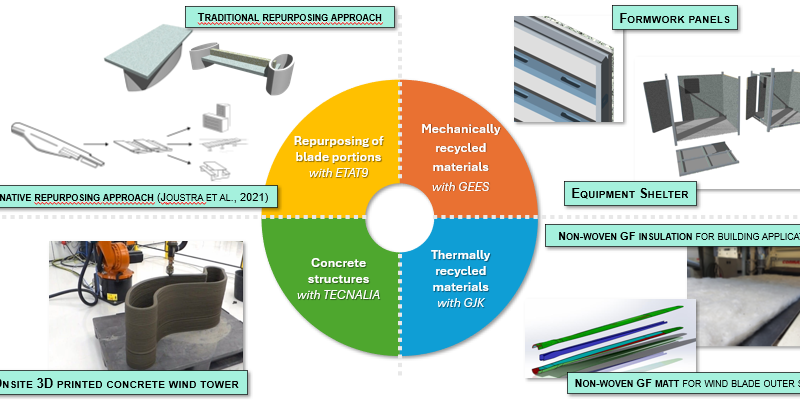


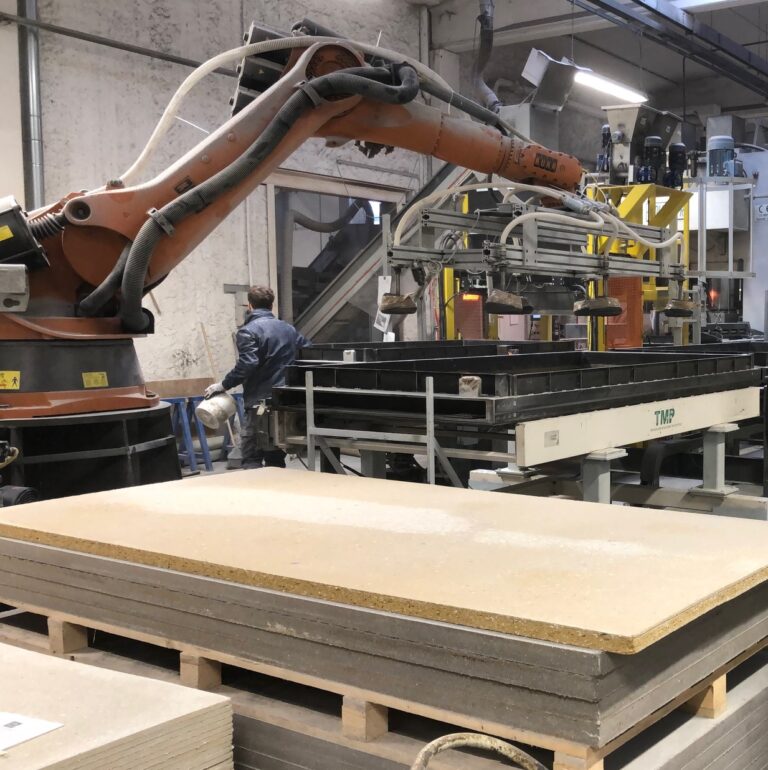
The Gees Recycling plant in Aviano.
Italian company Gees Recycling specialises in processing industrial waste materials. As part of the REFRESH project, Gees is using this expertise to design and build a plant to recycle end-of-use wind turbine blades into new products.
Gees Recycling was founded in 2010 with the objective of developing methods for recycling industrial materials, including glass fibre reinforced composites. After many years of testing, a mechanical recycling process was developed in a small plant in Budoia, Pordenone. The process has been awarded European and international patents. From 2018 this process has been operating in a pilot plant in Aviano, which is capable of recycling of more than 1,900 tons of composite materials per year. The Gees system is very flexible and its success has been demonstrated with many types of waste, including multi-component polymeric materials.
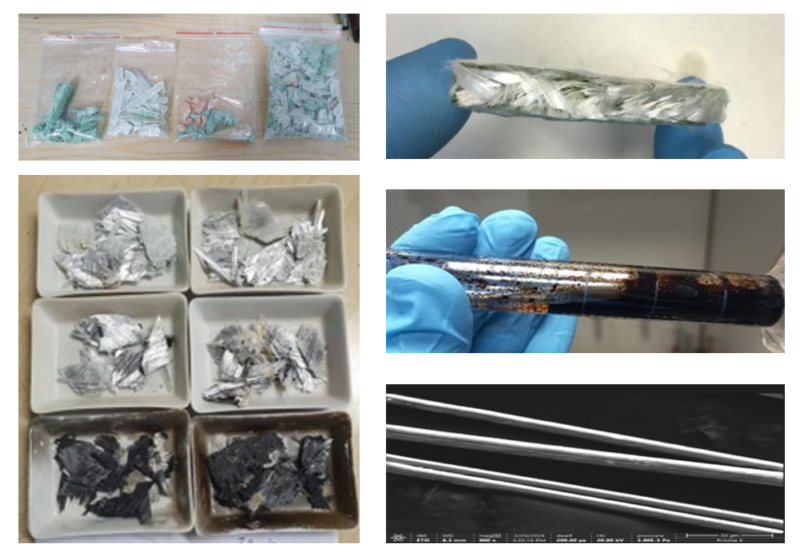
Gees is able to process a variety of composite wastes, including trims and scraps from laminates, particles and powders from finishing processes, waste from automotive or electrical products, and carbon fibre composites from bicycles and aerospace parts. The materials are shredded, milled, classified, and then added to resin and press-moulded at high pressure to produce rigid panels. The panels can be produced in various densities and thicknesses and have a range of potential applications in furniture, construction and other markets.
Gees Recycling’s role in REFRESH
The REFRESH project is exploiting Gees’ experience in adapting recycling processes to suit different materials, and ability to develop machines and plants from scratch, in the design of a new line for processing wind turbine blade materials.
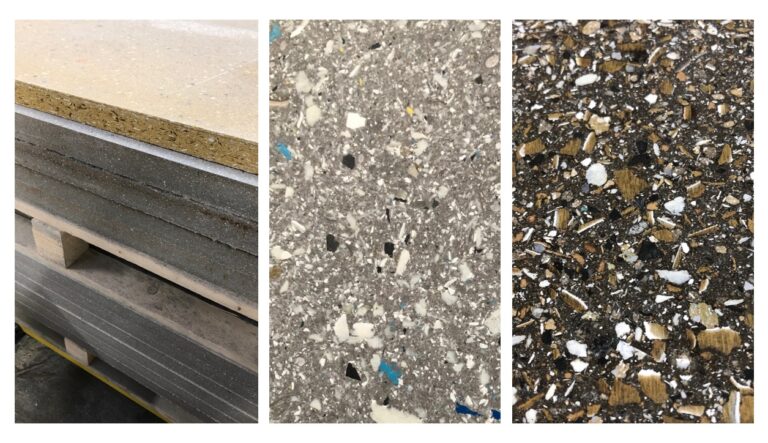
Panels of different thicknesses and surface finishes can be produced.
Gees is leading Work Package (WP) 2: Development and customisation of recycling processes, and WP 4: Process integration, demonstration and testing at TRL 7. In the REFRESH concept, various recycling options are being considered and so in addition to the Gees mechanical recycling process, Gjenkraft is developing its pyrolysis process, and CIRCE is exploring the potential of microwave-assisted thermal and solvothermal processes. WP 2 is focusing on the design and upscaling of the Gees mechanical recycling process and Gjenkraft thermal process and the design of thermo-chemical recycling processes. The main objective of WP4 is the building and testing of the upscaled mechanical recycling and pyrolysis plants.
A new value chain
We asked Giorgio Betteto, R&D CTO, about Gees’ role in the project.
Why did Gees Recycling decide to join REFRESH?
The recycling of wind turbine blades poses new technological challenges also for the mechanical recovery technologies in which Gees Recycling is an expert. Participating in the REFRESH project allows us to evaluate a series of specificities of high-performance epoxy matrix composites reinforced with glass and carbon fibre, and to implement specific production technologies for the recycling of EoW obtained from them.
The REFRESH project will allow us to equip ourselves and better respond to two growing requests for circularity in the composites sector; on the one hand, the demand for wind turbine recovery and recycling services from energy companies; on the other hand, the demand for sustainable and high-performance construction materials from the manufacturing industry.
What are the main advantages of the Gees mechanical recycling process for recycling composite materials?

There are many potential applications for the panels, in both exterior and interior parts.
The possibility of using the different types and components of composite products, regardless of fibre or resin type, giving value also to the lightest fractions like the core materials.
What special challenges do turbine blades present for your process and how will you solve these?
Blades have high-resistant parts hard to process, plus the difference in thickness and composition of the blade, where thickness change from 100 mm to 8 mm, require special engineering. The good thing is that we are used to such problems since we already recycle many different composite wastes.
What are the properties and potential applications of the panels produced?
The panels maintain the excellent resistance to water, weather and extreme climate of the original composite, making them a very good choice for any outdoor application.
The potential applications are many, some of them for the wind energy sector, as formwork panels for foundations, material for building shelters and containers for the connection equipment, as well as components for floating wind turbines. Apart this, many industrial applications are ready for these materials, like cold-chain flooring, naval and nautical components, to more exotic uses like motorway sound barriers made with repurposed blades and recycled panels or floating solar pontoons, or footbridges.
At the end of the project, what do you hope to have achieved?
Our objective is to create an entirely new value chain, where wind blades become a feedstock for innovative products that find their market, being price competitive, with superior performance, and with a much better environmental impact and carbon balance. Products that will be always recycled with the same process at end of their life.
Meet our other partners:
Meet the partners: Gjenkraft
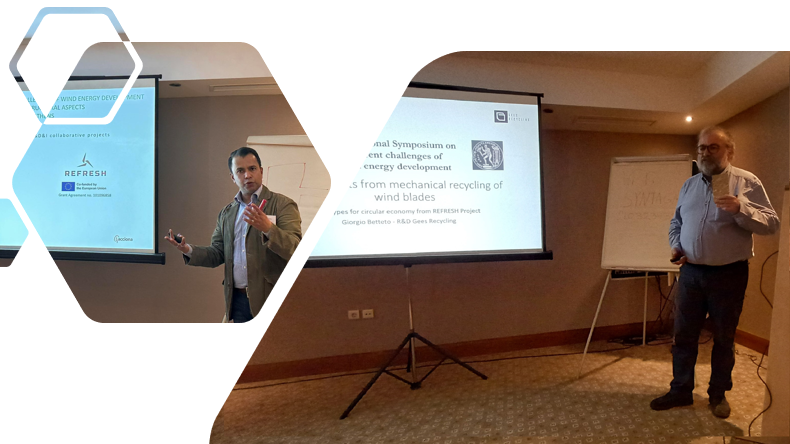
Acciona and Gees Recycling attend Athens wind energy symposium